A Better Way to Measure Ocean Wave Directions: From Research to Software
research updateHow wavelets help us understand where ocean waves come from, and why we built a Python toolkit to make this accessible to everyone.
The Problem with Measuring Wave Directions
Imagine standing on a beach during a storm. Waves are coming from multiple directions; some from a distant weather system, others being generated by local winds. Now imagine trying to measure exactly where all that wave energy is coming from at different frequencies. That’s the challenge oceanographers face when analysing wave buoy data.
For decades, we’ve relied on traditional methods based on Fourier analysis. Whilst these work reasonably well, they have limitations: they assume the sea state stays constant during measurements, often require assumptions about what the answer should look like, and can struggle when multiple wave systems overlap.
A Wavelet-Based Solution
In 2024, we published a paper in the Journal of Atmospheric and Oceanic Technology (Peláez-Zapata et al., 2024) introducing a wavelet-based approach to this problem. Using data from GPS wave buoys off the stormy west coast of Ireland, we showed that wavelets offer some real advantages:
Time-frequency localisation: Unlike Fourier methods that analyse the entire time series at once, wavelets let us zoom in on specific moments and frequencies simultaneously. This is crucial when sea states change rapidly.
No assumptions needed: The method is completely data-driven. We don’t need to assume the directional distribution has a particular shape or that conditions are stationary.
Robust results: The wavelet approach produced smoother, more stable directional estimates, even during complex storm conditions with overlapping wave systems.
We validated the method against conventional approaches and numerical models, and found it performed as well as or better than the best traditional methods, without their limiting assumptions.
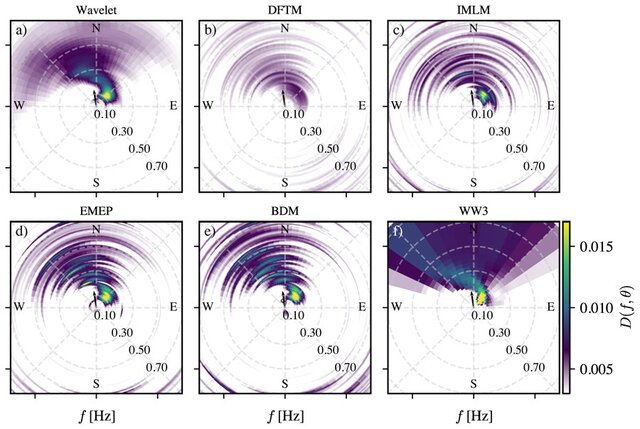
Figure: Example of directional wave spectra estimated using different methods. The radial axis shows frequency (Hz), whilst the angular direction shows where waves are going to (N, E, S, W). Colours indicate wave energy density at each frequency-direction combination.
From Paper to Practice: The EWDM Toolkit
Here’s the thing about academic papers—they demonstrate that something works, but they don’t necessarily make it easy for others to use. That’s why we built EWDM (Extended Wavelet Directional Method), an open-source Python toolkit that implements these wavelet-based algorithms.
EWDM was published in the Journal of Open Source Software (Peláez-Zapata & Dias, 2025) and makes this research accessible to the broader community. The toolkit:
- Works with diverse data sources: GPS buoys, pitch-roll buoys, wave staffs, ADCPs, and even stereo-video data.
- Integrates seamlessly with popular wave buoy systems like Spotter buoys and the CDIP database.
- Built on
xarray, making it efficient and compatible with modern scientific Python workflows. - Includes kernel density estimation for robust directional distribution assessment.
You can find it on GitHub: github.com/dspelaez/extended-wdm
Why This Matters
Accurate wave directional information isn’t just academically interesting—it has real-world applications:
-
Maritime safety: Understanding crossing seas and complex wave patterns helps prevent accidents
-
Coastal engineering: Better directional data improves harbour design and coastal defences
-
Renewable energy: Offshore wind farms and wave energy converters must withstand waves from multiple directions
-
Climate research: Long-term directional statistics help us understand how ocean wave patterns are changing
What We Learnt from the Irish Coast
Testing the method off Ireland’s west coast was ideal. This region sees the full fury of North Atlantic storms with complex, rapidly-changing wave conditions. One particularly interesting finding was that directional spreading (how widely waves are distributed around the main direction) didn’t depend much on wave age. This suggests that nonlinear wave-wave interactions play a bigger role than direct wind forcing in determining how waves spread out directionally. We also found that directional spreading was narrowest at the spectral peak (the dominant waves) and broadened asymmetrically at higher and lower frequencies.
Open Science in Action
This project embodies what open science should be: publish the research, release the code, make it easy for others to build on your work. EWDM is licensed under a permissive open-source licence, archived on Zenodo, and documented with examples.
Whether you’re processing data from a single buoy deployment or analysing long-term wave climate datasets, EWDM provides a flexible, assumption-free approach to directional spectrum estimation.
Getting Started
If you work with wave data and want to try the wavelet approach:
pip install ewdmThe GitHub repository includes documentation, examples, and Jupyter notebooks to get you started quickly.
Final Thoughts
Sometimes the best scientific progress comes from combining existing mathematical tools (wavelets have been around for decades) with domain expertise (understanding ocean waves) and a commitment to making the results accessible. That’s what this project represents.
And if you’re ever on the Irish coast watching massive swells roll in during a winter storm, you can appreciate the mathematical sophistication required to properly measure where all that wave energy is actually coming from—and know that there’s now a free tool available to do exactly that!
References:
-
Peláez-Zapata, D.S., et al. (2024). Ocean Wave Directional Distribution from GPS Buoy Observations off the West Coast of Ireland: Assessment of a Wavelet-Based Method. J. Atmos. Ocean. Technol. doi: 10.1175/JTECH-D-23-0058.1
-
Peláez-Zapata, D.S., & Dias, F. (2025). EWDM: A wavelet-based method for estimating directional spectra of ocean waves. J. Open Source Softw., 10(109), 7942. doi: 10.21105/joss.07942