A Drifting Buoy's Journey Through an Extreme Event: Recording the 2023 Marine Heatwave
research updateOur new paper in Scientific Data presents a unique high-resolution dataset captured by a serendipitously drifting buoy during the 2023 North Atlantic marine heatwave.
In June 2023, something extraordinary happened off the west coast of Ireland: sea surface temperatures climbed to an astonishing 4°C above their historical average. This wasn’t a localised anomaly or a measurement error, but part of a marine heatwave that engulfed the entire North Atlantic. According to preliminary research, it was one of the fastest warming trends observed in the past 40 years.
Incidentally, we had deployed a Spotter buoy off the Irish coast earlier that spring. When the buoy unexpectedly broke free from its mooring and began to drift, what could have been a setback became a scientific opportunity: the wandering buoy tracked the marine heatwave as it unfolded, capturing high-resolution data throughout the peak of the event. This serendipitous combination of circumstances offers a valuable opportunity to study the evolution of this unprecedented phenomenon.
Our new paper, recently published in Scientific Data, presents the high-resolution dataset recorded during this extreme event, making these unique in-situ observations available for future research.
Sea surface temperature evolution around Ireland during the 2023 marine heatwave. The animation shows the dramatic warming that occurred off the Irish west coast, with the yellow track indicating the drifting buoy trajectory capturing high-resolution data throughout the event.
What Are Marine Heatwaves?
Marine heatwaves are defined as extreme ocean temperature events where sea surface temperatures exceed the 90th percentile of historical records for at least five consecutive days. Think of them as the oceanic equivalent of atmospheric heatwaves, but with potentially longer-lasting impacts.
The consequences are severe and far-reaching. Coral reefs bleach, losing the symbiotic algae that give them both colour and life. Kelp forests collapse, reducing habitat for countless marine species. Fish populations migrate to cooler waters, disrupting fisheries and coastal economies. These aren’t abstract ecological concerns: they’re real impacts affecting coastal communities and marine industries worldwide.
The 2023 North Atlantic Event
The summer of 2023 brought an exceptional marine heatwave to the North Atlantic. Starting in late spring and intensifying through June and July, the event saw basin-wide warming that was unprecedented in both its spatial extent and intensity. What caused such dramatic heating?
Research indicates that persistent anticyclonic weather patterns were the primary driver. High-pressure systems brought exceptionally weak winds and extended periods of sunshine, reducing ocean mixing and allowing the upper ocean to absorb more solar radiation. The result was enhanced ocean stratification and rapidly rising water temperatures. Anomalous air-sea heat fluxes, influenced by unusually weak winds and a shallow surface mixed layer, were key mechanisms driving this extreme event.
The implications are profound. This wasn’t an isolated event but part of a broader pattern linked to our changing climate system.
Why Marine Heatwaves Matter for Climate
Marine heatwaves are projected to increase dramatically in frequency, intensity, and duration as the twenty-first century progresses. They’re not just symptoms of climate change; they’re active participants in climate feedback mechanisms.
The ocean plays a crucial role in Earth’s carbon cycle, absorbing roughly a quarter of anthropogenic CO₂ emissions. Marine heatwaves can disrupt this process, altering ocean-atmosphere CO₂ exchange and potentially accelerating climate change. They also affect atmospheric patterns, creating a two-way interaction between ocean and atmosphere that can influence weather systems far beyond the heatwave itself.
For coastal communities and marine industries, the stakes are existential. Fisheries depend on predictable marine ecosystems. Aquaculture operations require stable temperature conditions. Coastal tourism relies on healthy marine environments. Marine heatwaves threaten all of these, with socioeconomic consequences that ripple through entire regions.
The Missing Piece: High-Resolution Data
Understanding and predicting marine heatwaves requires detailed observations, yet acquiring co-located, in-situ measurements of ocean temperature, wind, and waves remains logistically challenging. Most monitoring relies on satellite data or reanalysis products with daily averages, which smooth out the fine-scale variability crucial for understanding air-sea interactions.
This is where the 2023 dataset becomes uniquely valuable. A Spotter buoy, deployed off the Aran Islands in April 2023, captured 1-minute resolution sea surface temperature measurements, 30-minute directional wave spectra, and wind speed estimates throughout the deployment. This deployment followed our previous work on bubble plume dynamics off the Irish coast, which highlighted the complex air-sea interactions in this energetic region. When the buoy broke free from its mooring on 1 June 2023, this incident became a stroke of fortune: the drifting buoy continued measuring throughout the peak of the marine heatwave, providing unique high-resolution and simultaneous measurements of waves, wind, and temperature during an extreme event.
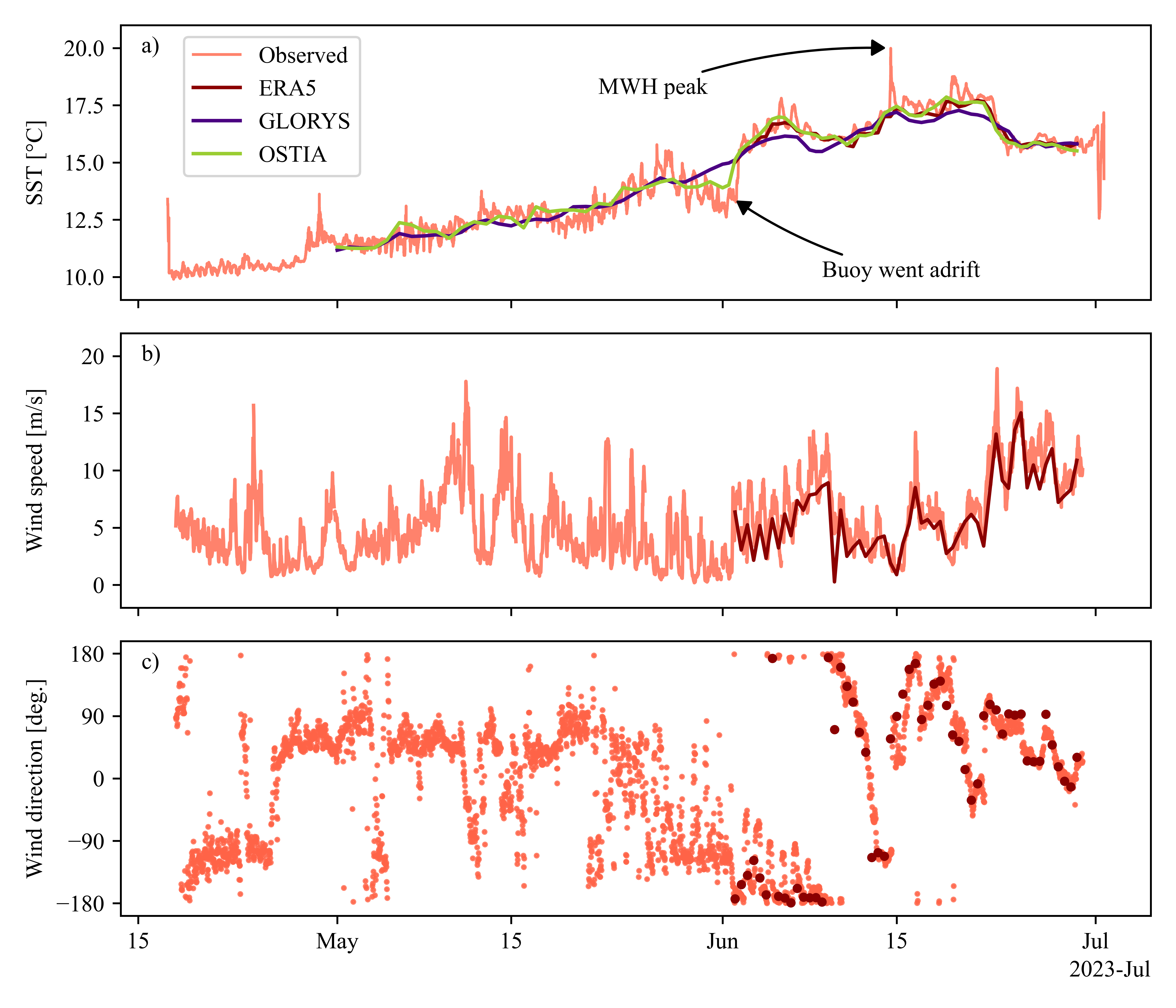
Time series showing the recorded sea surface temperature and wind speed estimates captured by the Spotter buoy during the peak of the 2023 North Atlantic marine heatwave.
Looking Forward
The 2023 North Atlantic marine heatwave won’t be the last. As our climate continues to warm, these events will become more frequent and more intense. The question isn’t whether another unprecedented heatwave will occur, but when.
Sustained, high-resolution observations are essential for monitoring these events, understanding their drivers, and improving our ability to predict them. The dataset from the 2023 deployment, offers researchers valuable data for model validation, diurnal warming studies, and data assimilation efforts.
Luck is not a strategy though. We need coordinated, long-term ocean observing systems that can capture both typical conditions and extreme events. We need to bridge the gap between satellite observations and in-situ measurements. Most importantly, we need to recognise that understanding marine heatwaves is not exclusively an academic exercise but a practical necessity for adaptation and mitigation strategies in our changing climate.
Further Reading
-
McCarthy, G. D., Brown, S., Cowton, T., Saravanan, P., Wunderlich, T., Janjic, T., Stendardo, I., & Hyder, P. (2023). The marine heatwave west of Ireland in June 2023. Weather, 78(11), 321-323. https://doi.org/10.1002/wea.4498
-
Shlesinger, T., & van Woesik, R. (2023). Oceanic differences in coral-bleaching responses to marine heatwaves. Science of the Total Environment, 871, 162113. https://doi.org/10.1016/j.scitotenv.2023.162113
-
Smale, D. A., et al. (2019). Marine heatwaves threaten global biodiversity and the provision of ecosystem services. Nature Climate Change, 9(4), 306-312. https://doi.org/10.1038/s41558-019-0412-1
-
Lacheheb, M., Noy, I., & Kahui, V. (2024). Marine heatwaves and commercial fishing in New Zealand. Science of the Total Environment, 954, 176558. https://doi.org/10.1016/j.scitotenv.2024.176558
-
Berthou, S., Renshaw, R., Smyth, T. et al. (2024). Exceptional atmospheric conditions in June 2023 generated a northwest European marine heatwave which contributed to breaking land temperature records. Communications Earth & Environment, 5, 287. https://doi.org/10.1038/s43247-024-01413-8
-
Li, C., Burger, F. A., Raible, C. C., & Frölicher, T. L. (2024). Observed Regional Impacts of Marine Heatwaves on Sea-Air CO₂ Exchange. Geophysical Research Letters, 51, e2024GL110379. https://doi.org/10.1029/2024GL110379
This post discusses data presented in “Sea Surface Temperature and Directional Wave Spectra During the 2023 Marine Heatwave in the North Atlantic” published in Scientific Data.