The Hidden World of Ocean Bubbles: Measuring What Lies Beneath Breaking Waves
research updateHow acoustic sensors are helping us understand the complex dynamics of bubble plumes created by breaking waves, and why these tiny bubbles matter for our climate.
The Invisible Orchestra of the Ocean Surface
When waves break, they don’t just create a spectacular display of white foam and spray, they inject countless bubbles into the ocean. These ephemeral bubble plumes might seem inconsequential, but they play a surprisingly important role in how our ocean and atmosphere interact. They mediate gas exchange between air and sea, influence aerosol production and affect nutrient and carbon cycles.
But here’s the challenge: these bubble clouds are transient, chaotic, and difficult to observe. How do you measure something that’s constantly forming, moving, and disappearing beneath a turbulent sea surface?
Listening to Bubbles with Sound
In our recent research, published in the Journal of Physical Oceanography (Peláez-Zapata et al., 2024), we tackled this problem using an unlikely tool: an acoustic Doppler current profiler (ADCP). Whilst ADCPs are typically used to measure ocean currents, they also happen to be excellent at detecting bubbles. Why? Because bubbles scatter sound waves particularly well, creating bright acoustic signatures that reveal their presence and depth.
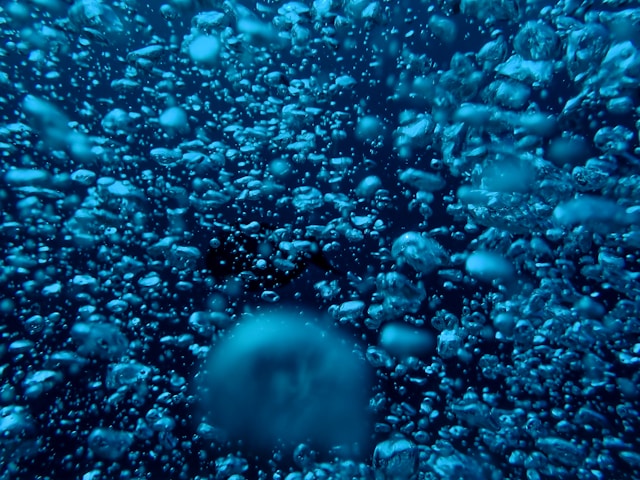
Photo by Jeremy Lanfranchi on Unsplash
We deployed a bottom-mounted, upward-looking ADCP off the west coast of Ireland, a particular well-suited location to study energetic breaking waves. For months, this instrument sent acoustic pings upwards through the water column, recording not just currents but also the acoustic backscatter from bubble clouds created by breaking waves up there.
What We Found
The data revealed fascinating patterns in bubble plume behaviour:
Wind speed controls how deep bubbles penetrate. We established a power-law relationship between wind speed and average bubble penetration depth. During calm conditions, bubbles stay near the surface. But during storms with high winds, some bubble plumes reached depths of 20 metres or more.
Wave age matters even more. Whilst wind speed is important, the stage of wave development explained up to 78% of bubble plume variability. Young, actively-growing waves (where the waves are slower than the wind) create conditions particularly favourable for deep bubble penetration.
The shape of randomness changes. During low winds, bubble depths vary erratically: some shallow, some surprisingly deep, with a highly skewed distribution. But as wind speeds increase, the distribution becomes more organised and symmetrical. This transition suggests that different physical mechanisms dominate at different wind speeds.
Langmuir circulation transports bubbles deeper. Perhaps the most interesting finding is the role of Langmuir circulation: those beautiful rows of surface convergence zones you sometimes see aligned with the wind. When conditions favour these organised vortices (characterised by a turbulent Langmuir number around 0.3), bubbles penetrate much deeper. The Langmuir cells essentially act as conveyor belts, transporting bubbles downwards more efficiently than turbulence alone.
Why This Matters
Understanding bubble dynamics isn’t just an academic curiosity, it has real implications for climate science and oceanography:
Carbon dioxide exchange: Bubbles increase the surface area for gas transfer between ocean and atmosphere. Better models of bubble plumes mean better predictions of CO₂ uptake by the ocean.
Aerosol production: When bubbles burst at the sea surface, they eject tiny droplets that become sea spray aerosols, which affect cloud formation and climate.
Upper ocean mixing: Bubble plumes interact with currents and turbulence, contributing to how the upper ocean mixes. This affects everything from nutrient distribution to the fate of pollutants and microplastics.
Predictive capabilities: The empirical relationships we’ve established provide practical tools for climate and ocean models to better represent air-sea interactions.
Science You Can Replicate
One particularly satisfying aspect of this work is its accessibility. ADCPs are commercial, off-the-shelf instruments used routinely in oceanography. We didn’t need extremely specialised equipment or sensors. This means this methodology can be replicated by research groups worldwide, potentially leading to a much broader understanding of bubble plume dynamics across different ocean regions and conditions.
The data processing techniques we developed can be applied to existing ADCP datasets that may have been collected for entirely different purposes. There’s likely a wealth of bubble information hiding in archived oceanographic data, waiting to be extracted.
Looking Beneath the Surface
This research adds another piece to the puzzle of how breaking waves inject energy, momentum, and gases into the ocean. The transition from sporadic, random bubble entrainment during low winds to organised, Langmuir-driven transport during storms reveals a rich complexity in what might seem like simple white foam.
Every time you watch waves breaking on a beach, there’s an invisible cascade happening beneath the surface, millions of bubbles being created, transported, dissolved, and rising. Understanding this process, quantifying it, and incorporating it into our models brings us closer to understanding the intricate relationship between the ocean and the atmosphere that shapes our climate.
And sometimes, all you need is a well-placed acoustic sensor listening patiently to the symphony of bubbles beneath the waves.
Reference:
- Peláez-Zapata, D.S., Pakrashi, V, Dias, F. (2024). Dynamics of Bubble Plumes Produced by Breaking Waves. J. Phys. Oceanogr., 54(10), 2059–2071. doi: 10.1175/JPO-D-23-0261.1